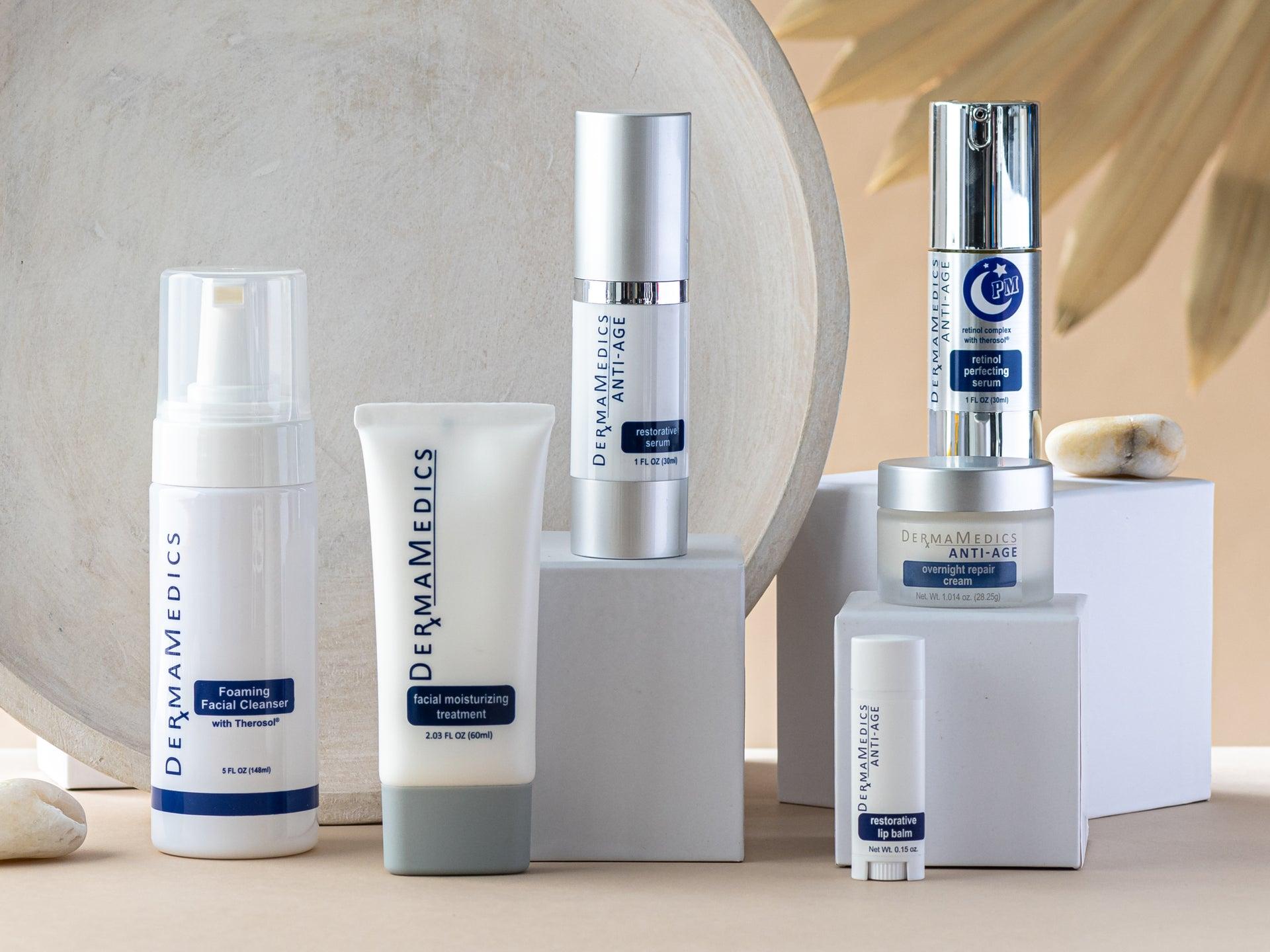
A private label skincare manufacturer helps skincare brands, aesthetic clinics, distributors, and professional beauty businesses turn product ideas into market-ready formulas. But for clinical-grade skincare, the decision is more complex than choosing a supplier with attractive packaging or low MOQ.
The right manufacturing partner should understand active ingredients, skin barrier repair, post-treatment care, stability, compliance, packaging compatibility, and scalable quality control. This is especially important for brands developing products such as peptide serums, freeze-dried skincare, HydraFacial boosters, post-procedure recovery kits, anti-aging formulas, and professional clinic care lines.
Menanora Biotech focuses on clinical-grade skincare R&D, OEM/private label manufacturing, and medical aesthetic care solutions. Through its full-service OEM process, Menanora supports brands from formula concept to production, packaging, quality control, and global delivery.
You can learn more about Menanora here:
https://www.menanora.com/
https://www.menanora.com/about-us
https://www.menanora.com/privatelabel-oem
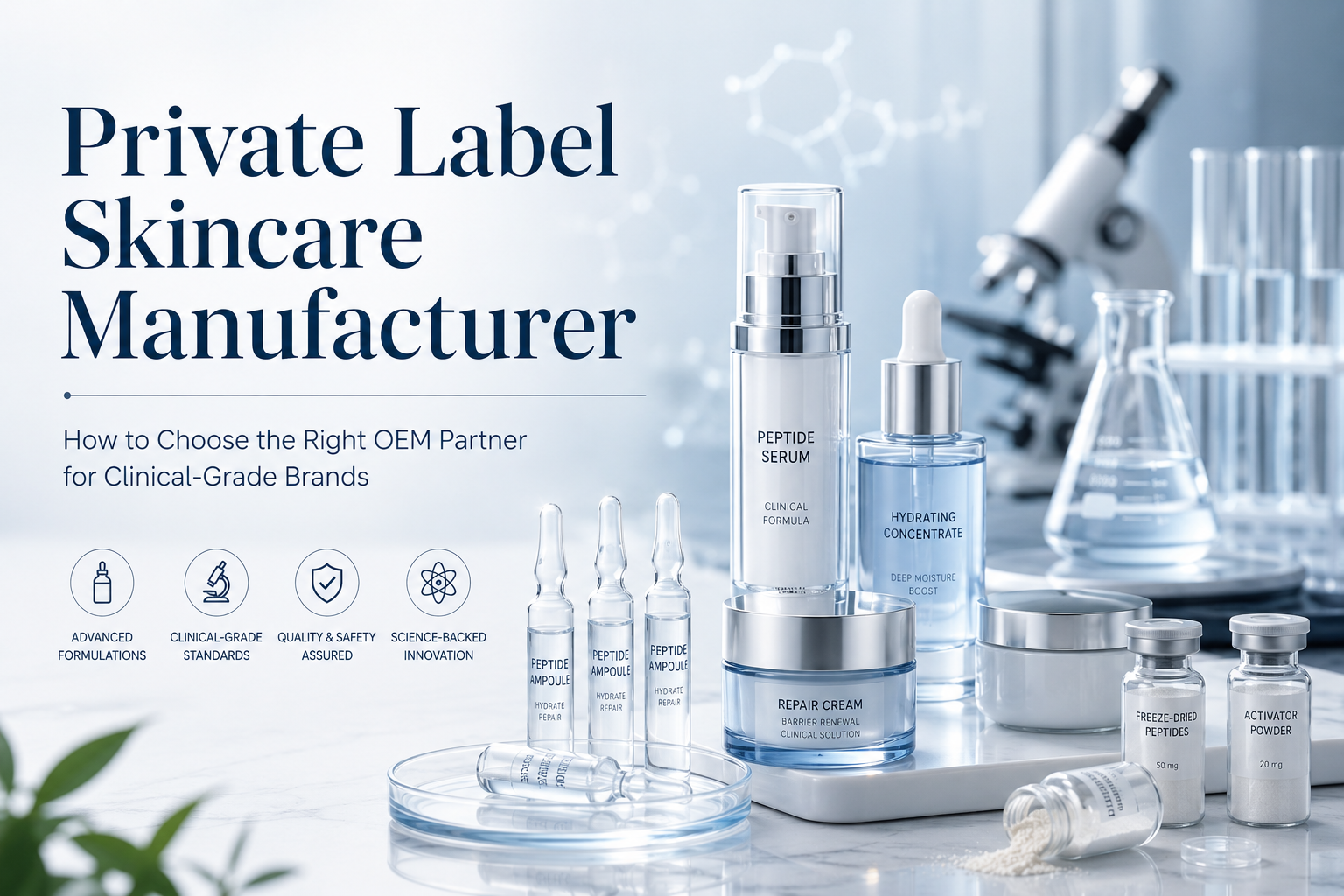
Quick Answer: What Makes a Good Private Label Skincare Manufacturer?
A good private label skincare manufacturer should provide more than basic production. It should offer formula R&D, ingredient guidance, packaging design, compliance support, GMP-based production, quality control, and after-sales service.
For clinical skincare brands, the manufacturer should also understand:
- Professional treatment scenarios
- Post-procedure skin recovery
- Peptides, PDRN, EGF, hyaluronic acid, collagen, and botanical actives
- Skin barrier repair
- Freeze-dried skincare technology
- Packaging stability
- Regional compliance requirements
- Long-term product line planning
This is why medical aesthetic clinics and professional skincare brands often prefer an OEM partner with both formulation experience and clinical care product knowledge.
Why Buyers Search for a Private Label Skincare Manufacturer
Most buyers searching for a private label skincare manufacturer are not only asking, “Who can make skincare products for me?” They are usually trying to solve deeper business problems.
They may want to launch a new skincare brand, expand a clinic product line, improve post-treatment care, create an anti-aging collection, or develop a differentiated formula that competitors cannot easily copy.
Common buyer questions include:
- Can the manufacturer develop a custom formula?
- Can I use my own logo and packaging?
- What product categories can be customized?
- Does the factory support clinical-grade skincare products?
- Can the manufacturer help with compliance and testing?
- What is the MOQ?
- How long does product development take?
- Can the products be used for aesthetic clinics?
- How do I reduce quality risks?
- Can the supplier support long-term reorders?
A strong article should answer these questions clearly instead of only repeating broad claims such as “high quality” or “best service.”
What Should a Private Label Skincare Manufacturer Provide?
A professional private label skincare partner should provide a complete service chain. For clinical skincare, each step affects product safety, stability, brand positioning, and customer trust.
1. Product Consultation and Brand Positioning
Before formula development begins, the manufacturer should understand the customer’s target market, sales channel, product positioning, price range, ingredient preferences, and packaging direction.
For example, a skincare brand selling online may need attractive packaging and strong hero ingredients. A medical aesthetic clinic may care more about post-treatment comfort, skin recovery, and professional protocol matching.
Menanora’s OEM process begins with consultation and product brief development. This helps define goals, target market, and product specifications before production starts.
2. Formula Development
Formula development is the core of private label skincare manufacturing. A basic supplier may only provide ready-made formulas, while a stronger OEM partner can support custom development based on product function, skin type, active ingredients, texture, and stability.
For clinical-grade skincare, common formula directions include:
- Hydration and barrier repair
- Anti-aging and firming
- Brightening and tone improvement
- Post-treatment soothing
- Peptide-based repair
- Freeze-dried active ingredient delivery
- Sensitive skin care
- Professional treatment support
Menanora’s R&D background is suitable for brands that need more than simple cosmetic formulas. Its product capabilities include HydraFacial boosters, lyophilized skincare, post-treatment recovery kits, and daily maintenance anti-aging products.
3. Packaging and Branding
Packaging is not only about appearance. It also affects formula protection, product shelf life, consumer experience, and brand value.
A reliable private label skincare manufacturer should help buyers choose suitable packaging forms, such as:
- Airless bottles
- Glass dropper bottles
- Ampoules
- Jars
- Sachets
- Freeze-dried vials
- Mask packaging
- Treatment kits
- Outer boxes and labels
For active formulas, packaging compatibility is especially important. Ingredients such as vitamin C, peptides, PDRN, EGF, and botanical extracts may require better protection from light, air, or contamination.
4. Compliance and Testing
Skincare brands should not ignore compliance. A product that looks attractive but lacks proper testing, documentation, or regulatory preparation can create serious risks when entering international markets.
A qualified manufacturer should support:
- Ingredient review
- Stability testing
- Packaging compatibility testing
- Microbial control
- Label review
- Production documentation
- Regional compliance support
- Quality traceability
For buyers targeting the United States, Europe, the Middle East, Southeast Asia, or professional clinic channels, compliance support should be discussed early rather than after packaging is completed.
5. Production and Quality Control
Production quality affects every batch, every reorder, and every customer review. A professional manufacturer should have clear production control, raw material management, batch records, inspection procedures, and finished product testing.
For clinical skincare brands, quality control should focus on:
- Formula consistency
- Texture and color stability
- Microbial safety
- Filling accuracy
- Packaging sealing
- Batch traceability
- Storage condition control
- Product appearance inspection
Menanora’s OEM page highlights production and quality control as part of its full private label process. This is important for buyers who want stable long-term supply instead of one-time product sourcing.
6. Logistics and After-Sales Support
The cooperation does not end when products leave the factory. A strong OEM partner should support global shipping, reorder management, packaging improvement, formula upgrades, and long-term product planning.
For growing skincare brands, this matters because successful products often need repeat production, seasonal upgrades, new packaging, or extended product lines.
Product Categories a Clinical Skincare Manufacturer Should Support
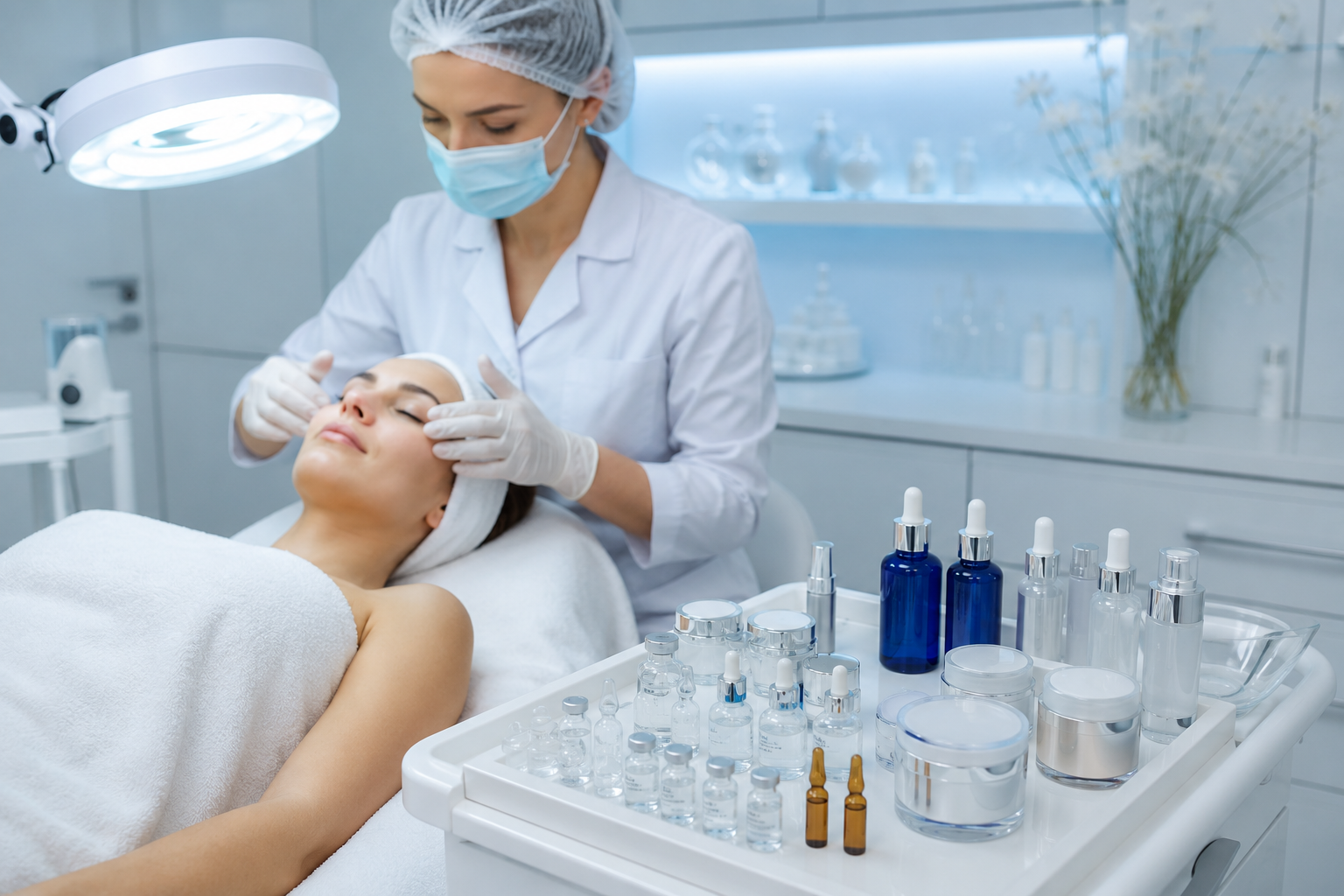
Not every private label skincare manufacturer is suitable for clinical-grade products. A professional clinical skincare OEM partner should support products that match real treatment and recovery scenarios.
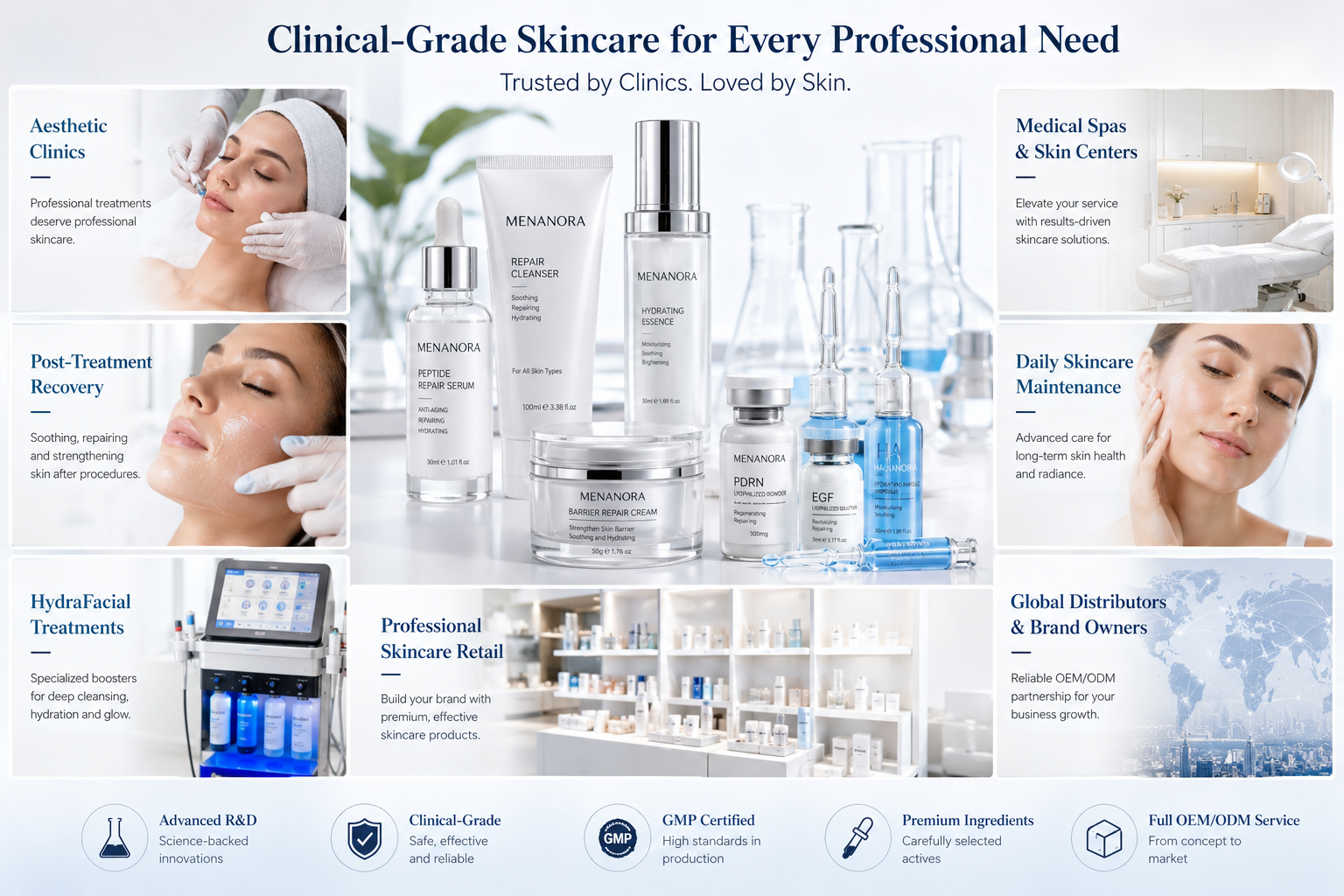
Menanora’s product structure can be divided into several major categories.
HydraFacial Boosters and Professional Treatment Solutions
HydraFacial-related products are commonly used by aesthetic clinics, skin management centers, and professional beauty institutions. These products need to support treatment results while remaining gentle and stable for professional use.
Typical product options include:
| Product Type | Key Function | Common Ingredients | Best For |
|---|---|---|---|
| HydraFacial Booster | Enhance treatment results | Hyaluronic acid, Vitamin C, Peptides | Clinics and skin centers |
| HydraFacial Solution | Cleansing and exfoliation | Salicylic acid, Citric acid, Allantoin | Professional facial treatments |
| Oxygen Infusion Serum | Deep nourishment | Marine collagen, Vitamin E, Zinc oxide | Hydration and recovery care |
These products are suitable for brands or clinics that want to create a professional treatment system rather than a single retail product.
Related page:
https://www.menanora.com/ForClinics
Freeze-Dried Skincare Series
Freeze-dried skincare is useful for formulas that contain sensitive active ingredients. By keeping certain ingredients in a stable dry format, brands can create high-value products for repair, anti-aging, hydration, and post-treatment care.
Common freeze-dried product types include:
- Freeze-dried serum
- Freeze-dried mask
- Lyophilized repair powder
- PDRN freeze-dried serum
- EGF repair serum
- Peptide active repair products
Menanora’s freeze-dried series includes products such as freeze-dried serum and freeze-dried mask, with active ingredients such as PDRN, EGF, hyaluronic acid, collagen, and peptides.
This category is suitable for premium skincare brands, aesthetic clinics, and distributors looking for differentiated products with a stronger professional image.
Post-Treatment Recovery Kits
Post-treatment skincare is one of the most important directions for clinical skincare brands. After laser, microneedling, peeling, or other aesthetic treatments, customers often need soothing, hydration, barrier repair, and ongoing maintenance.
A complete post-treatment system usually includes three stages:
| Stage | Product Direction | Usage Period | Main Purpose |
| Pre-Treatment Prep | Cleanser, toner, serum | 7–14 days before treatment | Prepare and condition skin |
| Immediate Recovery | Soothing spray, repair cream, mask | 0–48 hours after treatment | Calm, soothe, and repair |
| Long-Term Maintenance | Serum, cream, sunscreen | 3–14 days and ongoing | Maintain results and protect skin |
This structure is useful for clinics because it turns skincare into a repeatable protocol. It also helps brands create bundled product sets instead of relying only on single-item sales.
Daily Maintenance and Anti-Aging Products
A strong private label skincare manufacturer should also support daily skincare products that help customers maintain results after professional treatments.
Common product directions include:
- Anti-aging serum
- Peptide cream
- Moisturizing cream
- Barrier repair cream
- Brightening serum
- Sunscreen
- Sensitive skin repair products
- Hydrating mask
- Eye care products
These products can help clinics and skincare brands build long-term customer relationships. Instead of selling only one treatment or one hero product, the brand can create a complete care routine.
Key Ingredients for Clinical-Grade Private Label Skincare
Ingredient selection should match product function, skin type, market positioning, and regulatory requirements. For professional skincare products, active ingredients should be selected carefully and supported by stable formulation design.
Common ingredients include:
| Ingredient | Common Function | Product Application |
| Hyaluronic Acid | Hydration and plumping | Serums, masks, boosters |
| Peptides | Firming, repair, anti-aging support | Serums, creams, ampoules |
| PDRN | Recovery and rejuvenation positioning | Post-treatment products |
| EGF | Repair and renewal positioning | Freeze-dried serum, recovery care |
| Collagen | Nourishment and elasticity support | Masks, creams, treatment kits |
| Vitamin C | Brightening and antioxidant support | Serums, boosters |
| Allantoin | Soothing and comfort | Sensitive skin and recovery products |
| Salicylic Acid | Exfoliation and cleansing | Facial solutions and treatment products |
| Botanical Extracts | Calming and skin conditioning | Creams, masks, toners |
For clinical skincare brands, ingredient storytelling should be accurate and responsible. Avoid exaggerated medical claims. Instead, explain how each ingredient supports the product’s cosmetic function and user experience.
How to Compare Private Label, OEM, and ODM Skincare Services
Many buyers confuse private label, OEM, and ODM. A clear comparison can help buyers choose the right cooperation model.
| Service Type | What It Means | Best For | Flexibility | Development Time |
| Private Label | Use existing formula with your brand packaging | New brands, distributors, e-commerce sellers | Medium | Faster |
| OEM | Manufacturer produces according to your custom requirements | Brands with clear product ideas | High | Medium |
| ODM | Manufacturer provides formula, product concept, and production | Buyers needing product development support | High | Medium to longer |
| Full-Service OEM | Formula, packaging, compliance, production, logistics | Clinical skincare brands and clinics | Highest | Depends on complexity |
For clinical-grade skincare, a full-service OEM/private label model is often more useful because buyers need formula support, packaging advice, compliance preparation, and long-term product development.
How to Choose the Right Private Label Skincare Manufacturer
When choosing a private label skincare manufacturer, buyers should review both manufacturing capability and market fit.
Here is a practical checklist.
1. Does the Manufacturer Understand Your Product Category?
A factory that mainly produces simple lotions may not be the best partner for peptide serums, freeze-dried skincare, or post-procedure recovery kits.
Choose a manufacturer with experience in your target category.
2. Can It Support Custom Formulas?
If you want a differentiated brand, formula customization is important. Ask whether the manufacturer can adjust texture, ingredients, fragrance, color, active concentration, packaging type, and product positioning.
3. Does It Have R&D Capability?
R&D capability matters when developing clinical skincare products. Look for a partner that understands active ingredients, stability, skin feel, product safety, and real application scenarios.
4. Can It Support Packaging and Branding?
A good product needs packaging that matches the formula and the target market. Your manufacturer should help with packaging selection, label design, box structure, and brand presentation.
5. What Quality Control System Is Used?
Ask about raw material inspection, batch records, production control, microbial testing, filling inspection, packaging inspection, and final product release standards.
6. Can It Help With Compliance?
Compliance support is especially important for international skincare brands. The manufacturer should help prepare product information, label requirements, and testing documents according to the target market.
7. Can It Scale With Your Brand?
A good first order is not enough. Your private label partner should support reorders, product line expansion, packaging upgrades, and new formula development as your brand grows.
Why Menanora Is Suitable for Clinical Skincare OEM Projects
Menanora Biotech is positioned as a clinical skincare R&D and OEM/private label manufacturer. Its service model is suitable for buyers who need more than standard skincare production.
Key strengths include:
- Full-service OEM/private label support
- Formula R&D and product brief consultation
- Packaging and branding assistance
- Compliance and testing support
- GMP-based production and strict quality control
- Product categories for clinics and professional skincare brands
- HydraFacial boosters and ampoules
- Lyophilized skincare series
- Post-treatment recovery kits
- Daily maintenance and anti-aging products
- Experience with clinical aesthetic care solutions
For clinics, Menanora can support skincare protocols before, during, and after professional treatments. For skincare brands, it can help develop differentiated product lines with active ingredients, professional packaging, and scalable manufacturing support.
Explore Menanora’s OEM service:
https://www.menanora.com/privatelabel-oem
Explore clinical care solutions:
https://www.menanora.com/ForClinics
Explore company background:
https://www.menanora.com/about-us
Common Risks When Choosing a Skincare Manufacturer
Choosing the wrong private label skincare supplier can create hidden risks.
Risk 1: Weak Formula Differentiation
Some suppliers only offer generic formulas that many other brands already use. This makes it difficult to build a unique market position.
Risk 2: Poor Packaging Compatibility
An unstable formula or unsuitable packaging can cause leakage, discoloration, odor change, or reduced customer trust.
Risk 3: Incomplete Compliance Support
Without proper documentation and label review, brands may face delays when entering new markets.
Risk 4: Inconsistent Quality
Batch-to-batch inconsistency can damage brand reputation and increase customer complaints.
Risk 5: No Long-Term Product Strategy
A supplier may produce one product, but a real manufacturing partner helps build a complete product line.
This is why buyers should evaluate the manufacturer’s R&D, quality system, product categories, and OEM process before making a decision.
Best Product Line Ideas for Private Label Clinical Skincare Brands
For buyers planning a new clinical skincare brand, the following product line structures are easier to position and sell.
1. Post-Treatment Recovery Line
- Soothing spray
- Repair cream
- Recovery mask
- Barrier repair serum
- Sunscreen
Best for aesthetic clinics and post-procedure skincare brands.
2. Peptide Anti-Aging Line
- Peptide serum
- Firming cream
- Eye cream
- Collagen mask
- Anti-aging ampoules
Best for premium skincare brands and professional beauty channels.
3. Hydration and Barrier Repair Line
- Hyaluronic acid serum
- Moisturizing cream
- Sensitive skin toner
- Barrier repair mask
- Daily repair lotion
Best for sensitive skin and everyday skincare markets.
4. Freeze-Dried Active Care Line
- Freeze-dried serum
- Freeze-dried mask
- PDRN ampoule
- EGF repair product
- Peptide repair powder
Best for high-end clinical skincare and differentiated brand positioning.
5. Clinic Protocol Kit
- Pre-treatment cleanser
- Treatment booster
- Immediate recovery spray
- Repair cream
- Long-term maintenance serum
Best for aesthetic clinics and professional treatment providers.
FAQ
1. What is a private label skincare manufacturer?
A private label skincare manufacturer produces skincare products that can be sold under your own brand name. The manufacturer may provide existing formulas, custom formulas, packaging, production, quality control, and logistics support.
2. How do I choose a private label skincare manufacturer?
Choose a manufacturer based on formula R&D capability, product category experience, packaging support, compliance knowledge, quality control, MOQ, lead time, and ability to support long-term product line development.
3. What products can Menanora manufacture for private label skincare brands?
Menanora supports clinical skincare products such as HydraFacial boosters, lyophilized skincare, post-treatment recovery kits, peptide skincare, daily maintenance products, anti-aging formulas, and professional clinic care solutions.
4. Is private label skincare suitable for aesthetic clinics?
Yes. Private label skincare is suitable for aesthetic clinics that want to create branded post-treatment care kits, hydration products, repair creams, anti-aging products, and long-term maintenance skincare systems.
5. What is the difference between OEM and private label skincare?
Private label usually uses existing formulas with your brand packaging, while OEM often involves more customized product development based on your specific formula, packaging, ingredient, or market requirements.
6. Can I customize the formula and packaging?
Yes. A full-service private label skincare manufacturer can support formula customization, active ingredient selection, texture adjustment, packaging sourcing, label design, and outer box development.
7. What ingredients are common in clinical skincare products?
Common ingredients include hyaluronic acid, peptides, PDRN, EGF, collagen, vitamin C, allantoin, salicylic acid, botanical extracts, and barrier-supporting moisturizers.
8. Why is quality control important for skincare manufacturing?
Quality control helps maintain formula consistency, product safety, batch traceability, packaging performance, and customer trust. It is especially important for clinical-grade skincare and post-treatment care products.
9. Can Menanora help with post-treatment skincare kits?
Yes. Menanora offers clinical care solutions that cover pre-treatment preparation, 0–48 hour post-treatment recovery, and 3–14 day long-term maintenance.
10. Who should work with a clinical private label skincare manufacturer?
A clinical private label skincare manufacturer is suitable for skincare brands, aesthetic clinics, medical beauty institutions, professional beauty distributors, e-commerce skincare brands, and global OEM/ODM buyers.
Conclusion: A Private Label Skincare Manufacturer Should Be a Long-Term Growth Partner
A private label skincare manufacturer should not only make products. The right partner should help you reduce development risk, create differentiated formulas, choose suitable packaging, meet compliance needs, maintain quality, and build a product line that can grow with your brand.
For clinical skincare brands, medical aesthetic clinics, distributors, and professional beauty businesses, the best manufacturer is one that understands both formulation science and real treatment scenarios.
Menanora Biotech supports private label and OEM skincare projects with clinical-grade product capabilities, R&D support, packaging assistance, compliance preparation, production quality control, and global delivery.
If you are planning to develop post-treatment skincare, peptide serums, freeze-dried skincare, HydraFacial boosters, or anti-aging products, Menanora can help turn your skincare concept into a market-ready product line.
Contact Menanora to start your OEM/private label skincare project:
https://www.menanora.com/privatelabel-oem